The-EEE PO-LI-TICIANS! Analysis and Comments on Urinetown
*Many spoilers for the musical ahead
I went to see Urinetown: The Muuusical! on March 13 and 15, 2026, as I hope all of you did. Not only was it an incredible display of our theater program’s long work hours, talent, and love of the art form, but also a somewhat nihilistic and very relevant warning of humanity’s future. I don’t feel like structuring this 50-percent-review-kinda-but-it’s-personal, so this article will be my various notes as they came to me all at once.
A cautionary tale about idealism and conservation, obviously. The rebellion was literally started by a one-dimensional hero archetype who has no plan to replace the system he’s trying to abolish other than “give everyone whatever they want” and who is succeeded by a rich, supposedly-well-educated girl who doesn’t have a plan either, so it’s all up to the people to make it work. Sure, Hope and Penny got everyone into the UGC (Urine Good Company) headquarters, but the people actually killed Caldwell. But because they were too swept up in the pursuit of immediate freedom and better living circumstances to “think of tomorrow,” no one questioned Bobby or Hope and everyone died. Even after overthrowing her father, Hope refuses to listen to Mr. McQueen when he brings up the research he commissioned before his death just because he was an enemy of justice/the people. In that way, the story is also about the dangers of groupthink. There are no antagonists, just the characters’ faults and lack of communication driving them to self-destruction.
It’s also not “capitalism is good.” While it is revealed that UGC’s methods were successful, I feel that that was only brought up in relation to the poor job Hope did (but it’s also because it’s a satirical, gut-punching musical). UGC’s members were unquestionably corrupt, owning private toilets, taking expensive vacations, and using their monopoly to squeeze out what little money the people had, which they were actively funneling away from research. That’s part of one of the musical’s big questions - would you fight the good fight even if your efforts amount to nothing (but die happy), or bear living under a bad system for a greater goal (if it’s actually being worked towards)? Assuming the people did know that Hope wasn’t going to make an alternative water system, did they just accept that and choose to die happy? The last line of the musical is that “they were prepared for the world they inherited.”
Capitalism can regulate water consumption, but those benefiting most from it will become corrupted and use their control of the market to take advantage of the people. The people can free themselves, but will have no checks. The true solution - Malthus’ solution - is to make sure the population never expands beyond its resources (water), and that means throwing people off of buildings.
The leg pop*. Why did she stop doing it? What does it mean? Is that even what it’s called?
Losing some of her airheadedness and becoming more grounded. She did it while being held hostage (dedication to the look!) and stopped after becoming the rebel leader, chasing a much weightier goal than being the “that’s me, I’m daddy’s girl!”
On opening night, the step was timed perfectly to the band coming in after “You’re much better than that, Hope!” in “Don’t Be the Bunny.” That detail sold the musical for me. I forgot what happened on Sunday.
Caldwell did it too, so maybe it’s a thing everyone decided would be funny.
*Hope would take a small step out with her foot every time the word “hope” was said in her presence.
Love is surface-level? This one completely stems from Little Sally’s question to Hope about love having a place in the new world, to which Hope responds “Oh, yes. And love.” in a noncommittal way. Girl, you literally started this rebellion because you loved someone. You even sang about it at the end instead of trying to fix the water crisis. Love is otherwise emphasized throughout the musical, so why was that line said that way? Perhaps she just needed a little reminder.
The fog machines did not work as intended on Sunday during the flashlight sequence in “Cop Song,” making the light beams of the flashlights invisible whilst they were visible on Friday. My condolences, but I’m very interested in why that happened.
Little Sally and Officer Lockstock are immortal entities that preside over the theaters in which Urinetown is performed. They are born in the first show and stay there forever, watching the other musicals until it is their time to descend into the lower planes of “Urinetown” again. Their joy lessens over time as they play along with the script, contenting themselves instead by watching other, happier musicals.
Hope is also manipulator, just not in the same way as her father. Well, she did say that she learned how “to manipulate great masses of people” at The Most Expensive University in the World. While Caldwell bought the loyalty of those who sided with him, even attempting to buy Bobby’s silence, Hope’s justification for leading the rebellion is just because “Bobby - your hero - loved me.” While the rest of her campaign was morally correct, and she was probably helped by Penny’s sudden reveal and heel turn, I don’t think “he loved me” is very solid evidence. That sentence uses the people’s love for Bobby and gets them to apply that love to her when they don’t know what she’s really like. I realize I’m nitpicking this one thing and there are multiple other factors that contributed to Hope’s ascension which I’ve just listed. Still, it is just a tiny bit of manipulation…
Speaking without the musical in mind, is manipulation for “the right thing” still manipulation? To me, it is. Is **** wrapped in gold still ****?
The Oxford Languages/Google defines manipulation as “the action of manipulating someone in a clever or unscrupulous way.”
This is not intended to be a “when a woman does it, it’s calculated” kind of take. Caldwell is an incomparably worse person than Hope and Bobby was drunk on his heart’s visions of freedom after Hope unlocked them, which she did without knowing the consequences.
I like that Mrs. Millennium was dressed more like a pageant winner instead of a standout employee. It shows that UGC has a hold on culture as well, and hints at some efforts to make their corruption more palatable through sponsoring different events. If she’s in on it enough to be regularly invited to UGC headquarters, maybe there’s an area like the Hunger Games’ District 1-3 where she’s an idol of some sort.
The parallel between Little Sally counting pennies up to 500 and Senator Fipp counting bills upwards of 622. That also sold the musical for me.
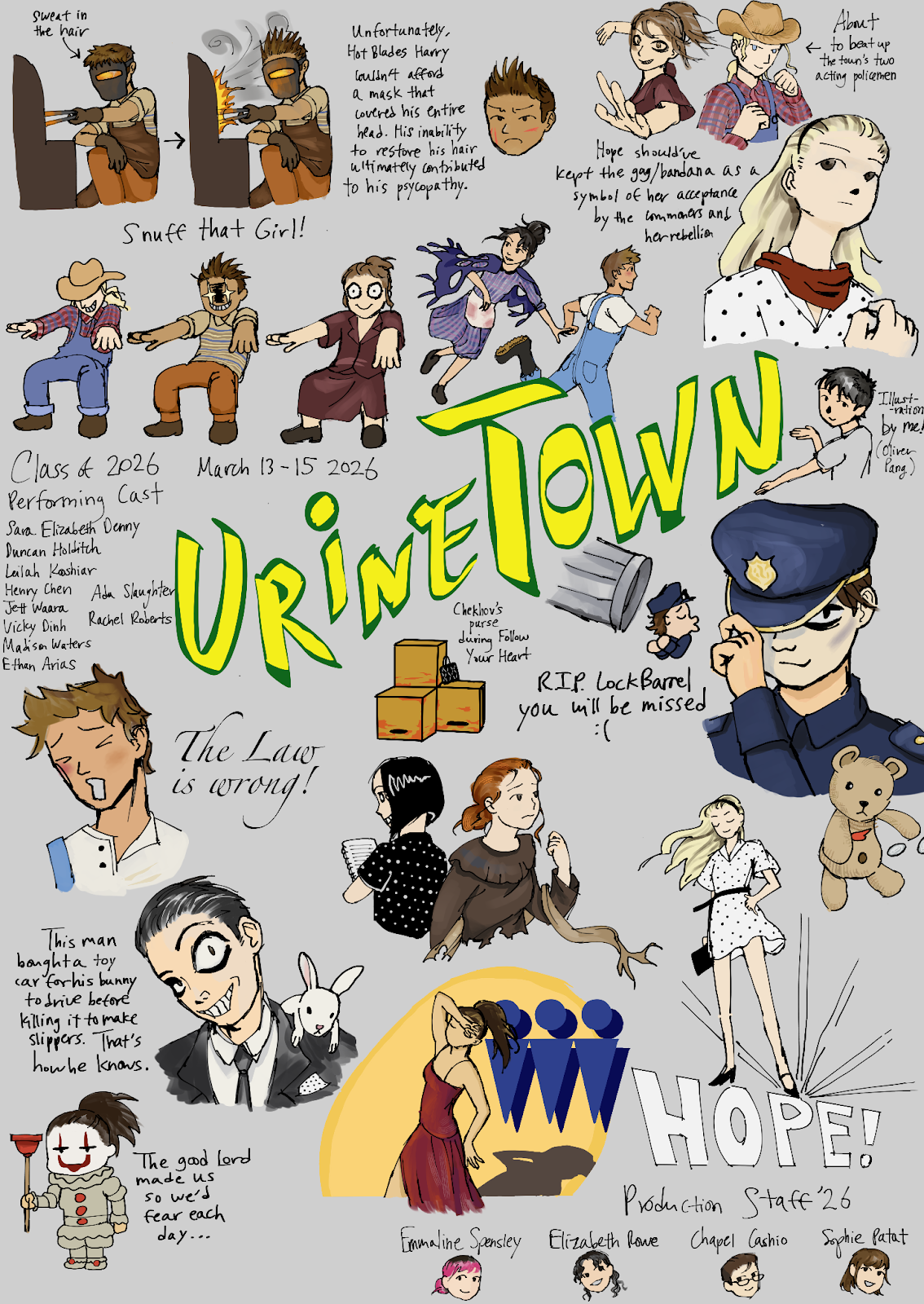
10/10, 9 notes. Also, here’s a poster I drew instead of working on my AP Studio Art portfolio of the seniors who were in it so you have something to remember us by: