Study Tips When You Don't Have Technology
How Does Memory Even Work?
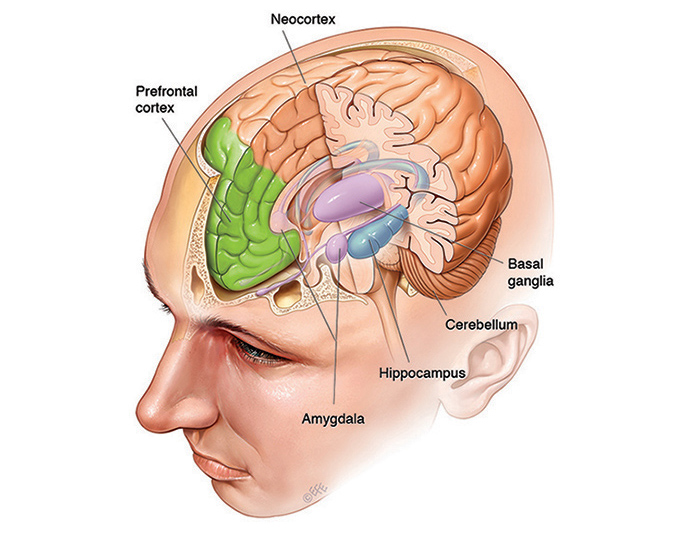
Your brain does not remember exactly what you were doing at 12:48 on Sunday last week. I don’t mean where you were. I mean what exactly you were doing. Were you talking? Walking? Singing? Drinking water? There are reasons you do not remember these tiny details. Many parts of the brain are responsible for different functions pertaining to memory. The hippocampus turns short-term memory into long-term memory. Over time, information from certain memories that are temporarily stored in the hippocampus can be transferred to the neocortex as general knowledge. The prefrontal cortex helps hold information in the mind right now, and is also known as the working memory. It also decides what to get rid of or forget. The basal ganglia are structures deep within the brain and are involved in a wide range of processes such as emotion, reward processing, habit formation, and movement. The hippocampus and the prefrontal cortex are crucial when it comes to studying.
While all of these parts of the brain are used for memory, we do not remember everything. Human beings forget many things that they are told or taught in school. If you do remember something very specific, then you might be like a case that was documented in 1968. This case was about a man who had an incredible memory and remembered every little detail of everything he had done. He had to actively try to forget things. The man, Solomon Veniaminovich Shereshevsky, was Russian and described things as speculative (умозрительный), which in Russian means “seen with the mind.” He later suffered in life from this.
This case was unusual. The majority of human brains are programmed to forget what is unnecessary. Forgetting is something that the human brain has developed through evolution as a survival mechanism.
Why Do We Forget So Much?
The brain keeps what it needs and discards the rest to make room for more important things. This is also a mechanism to optimize decision making in loud and chaotic changing environments. This is why you forget so much of what you learn in school. That is not to say that what we learn is not important.
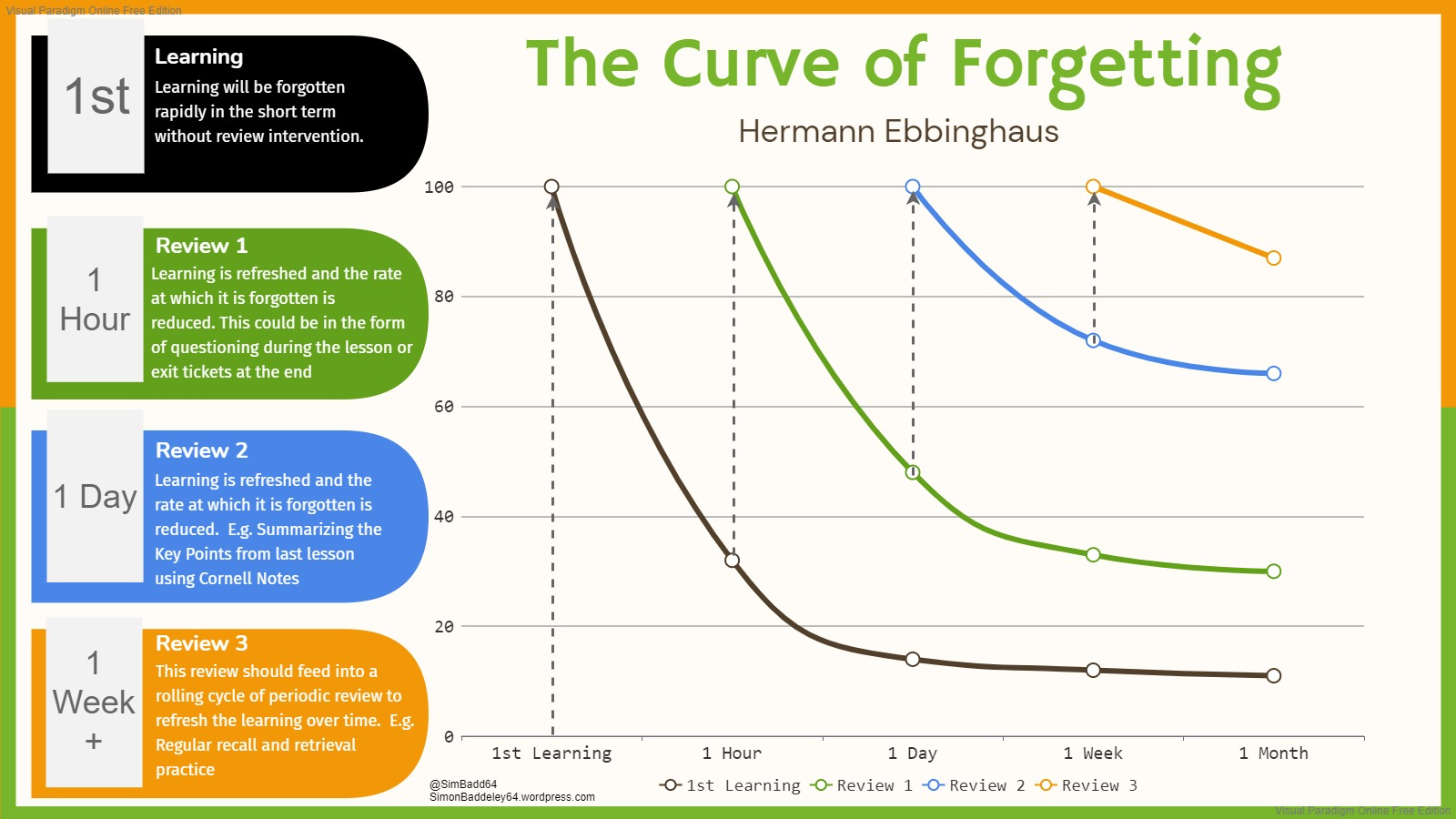
This is directly linked to the curve of forgetting. If you have ever taken 9th-grade Biology from Dr. Sides, you have probably heard of this. The curve of forgetting is the rate at which the human brain forgets information over time. The time when you lose the most information is within an hour of learning it. If you were to review the information that you learned, then you would be bringing the level of information that you know back to the top. You would forget just a bit less in the next 24 hours than you did in the first hour. If you review it in those 24 hours, you bump that level of knowledge right back up to the top again, and you forget more slowly. If you review it again within the week, then it gets bumped again, and you forget even less and at a slower rate. Doing this again within the month would make your memory even better. All that said, reviewing information is one of the best things you can do for yourself in school.
How do you learn best?
I think before you can even try to study efficiently, you need to understand, somewhat, how your brain works. If you have noticed that some of the things in one of these categories apply to you then great! Go to the study tips for those kinds of learners. The other strategies may work for you but the ones that are labelled as ‘good for this type of learner’ are most likely going to be better.
Visual learners: Learn things best when information is presented in patterns, shapes, or other visual aids. Flow charts are helpful. Visual learners do not necessarily learn well from videos even though they are visual. Videos also rely on auditory learning to have their full effect.
Auditory learners: Auditory learners learn best when information is heard or spoken. Lectures, group discussions, and other ways of talking through information help many auditory learners. Auditory learners often sort things out by speaking. They do not as often sort through things and then speak. Audio recordings of classes may help to understand information and answer questions. Teaching other people about something also helps retain information. Always ask your teacher before you record a class.
Reading or Writing Preference: People who like to read and write take in information by reading it and rewriting it. These people may do better on papers than a multiple choice test. Describing a chart or process by writing it out (not typing) will help to further understand material and retain information.
Kinesthetic learners: Tactile learning is helpful. Building a model of a chart to show connections between thoughts would help enforce information with a physical thing to represent it. These kinds of learners also apply things through reality and experiences rather than writing it out. Writing it out may work for some kinesthetic learners and not for others.
Logical Learners: These types of learners learn best when they have something to analyze and think about logically instead of theoretically. Looking for connections, patterns, causes, and results to things help to understand information.
Some people learn better in groups while others learn best on their own. Most times, in class, people have to work together. If you learn well working with others then find a study buddy and ask each other questions about the material. If you work better alone then you can write questions down and answer them yourself to absorb information.
Ways to Actually Retain Information
While there is a base level of “this does this, and that does that" when it comes to memory, everyone takes in information in their own ways. This is why we should learn about the many ways to memorize. It will make learning more productive.
Timing:
Another strategy that can be applied to many things is the pomodoro timer. This is exactly what it sounds like: a timer. You set a timer and work for that entire time and then you take a five minute break. You repeat this until you know everything. Every time you study for a block you take a five minute longer break. You use other study methods during this time but this helps with procrastination and staying focused.
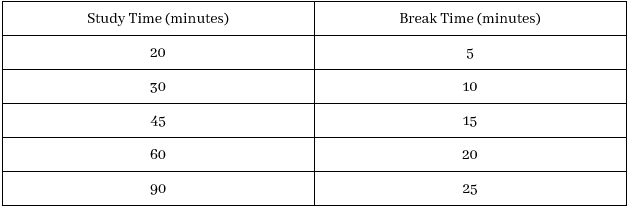
Another method like the pomodoro timer is the five minute method. You study something for five minutes. If you want to keep going then you do. Or you can take a break and try again later. This is a method used for procrastination. It tricks your brain into thinking it is a small task to study something. This works because it bypasses your brain’s psychological resistance to starting the task if you tell it ‘just five minutes.’ It also creates momentum known as the Zeigarnik effect because once your brain starts something it will want to finish it (If you are neurotypical. If not then it's a 50/50 chance that this will work.) You can also start the pomodoro timer using this. Five minutes on two minutes off and build up like the table above.
There are studying strategies that can be applied to memorization and comprehension. One of these is chunking. It has a weird name but it really does work. All you have to do is take a large amount of information and split it into smaller groups or chunks. This makes it less overwhelming to look at and gives less time to forget something before you go back to it again. For example: if you have 50 flash cards, split them into five groups of ten. There is less time in between when you come across a word or term for the first and second time.
Active Recall:
You might be trying to memorize vocab for a class or maybe the capitals for Dr. Cooper. First of all, no one is born with perfect memorizing skills. It can be trained and learned. If you think you are bad at memorizing then you just haven't found the most effective way for your brain yet. This goes for any kind of studying.
Teach the material you are learning to someone else. This can be your parents or a stuffed animal or your dog. It doesn’t matter. I personally recommend parents because they can ask you questions after but anything works. This is also a form of active recall. Active recall helps take things from your short-term memory and put them into your long-term memory.
Test yourself. Make a practice test and fill it out. This can show you gaps in memory and also simulate what it will be like on the day of the test you are preparing for.
Blurting: This is a form of active recall where you write down everything you know about a topic without references. You can do this to figure out what you know before you start studying. This is a way that your brain can show you what you know and what you don't and is very useful for figuring out what to work on for the next thirty minutes that you are going to be studying.
There are many ways to memorize things. One of them is flashcards. This is something that most people use but many of us use Quizlet. While Quizlet might seem like it does the same thing, it doesn’t. It is still not the most effective. Writing flashcards with a pencil/pen and paper connects the information to your brain with muscle memory. This is more effective than simply flipping flashcards on Quizlet. It can also be done without a phone or computer! This works for most everyone.
For Auditory learners: You can ask someone to read something out to you or read it out loud to yourself. Speaking it links something in your memory but so does hearing it. Saying it out loud does both of these things because you can hear yourself talking.
Interleaving: this is the method of studying something for a little while and immediately switching to doing something else before coming back to it again. This gives your brain a minute to get used to the new information and make pathways while you do something else for a bit.
Repetition: You can not do something once and expect it to stick. In order to remember things you have to go over them multiple times. This is proved by the curve of forgetting. Flash cards are great for repetition. Saying things out loud repeatedly is helpful as well. This is one of those methods that can be used along with other things as well.
Memory Links:
Another thing that helps with memorization is linking a word to its meaning. Assuming you are studying a language, you could link a word to its English definition with a logical train of thought. For example, pomme is apple in french and it sounds slightly like palm and an apple fits in the palm of your hand so therefore it is pomme.
Similar to this you can also link things you are trying to memorize to things you already know. For example, say you are trying to memorize the fact that water at sea level boils at 212 degrees Fahrenheit, and 212 happens to be the first three digits of your best friend’s phone number. Link these two by imagining throwing your phone into a boiling ocean. It’s a crazy link, but it can help that fact to stick.
Sleep on it. Review something before you go to bed even if only for a few minutes. Studies have shown that when you sleep your brain processes and stores information. This means that sleeping does actually help and pulling an all nighter to study does not!
If you get bored while studying, the five minute method is great but you can also listen to music. If you can still focus with music playing, then I recommend lofi music because it actually helps your brain take in and retain information. It is also less distracting because it has no words. If you want the music to have words you could also listen to music in a different language.
Works Cited
Neuron, vol. 94, no. 6. Cell.com, https://www.cell.com/neuron/fulltext/S0896-6273(17)30365-3?_returnURL=https%3A%2F%2Flinkinghub.elsevier.com%2Fretrieve%2Fpii%2FS0896627317303653%3Fshowall%3Dtrue. Accessed 24 August 2026.
“The Curve of Forgetting.” Simon Baddeley, 9 June 2021, https://simonbaddeley64.wordpress.com/2021/06/09/the-curve-of-forgetting/. Accessed 24 August 2026.
“8 Types of Learning Styles | The Definitive Guide.” Bay Atlantic University, https://bau.edu/blog/types-of-learning-styles/#logical-analytical-learners. Accessed 23 August 2026.
“4 Types of Learners in Education.” Teaching Channel, https://www.teachingchannel.com/k12-hub/blog/4-types-of-learners-in-education/. Accessed 23 August 2026.
“Memorization Strategies – The Learning Center.” UNC Learning Center, https://learningcenter.unc.edu/tips-and-tools/enhancing-your-memory/. Accessed 23 August 2026.
Terada, Youki. “Why Students Forget—and What You Can Do About It.” Edutopia, https://www.edutopia.org/article/why-students-forget-and-what-you-can-do-about-it/. Accessed 23 August 2026.
“Where are memories stored in the brain? - Queensland Brain Institute - University of Queensland.” Queensland Brain Institute, https://qbi.uq.edu.au/memory/where-are-memories-stored. Accessed 23 August 2026.